
How can creative methods contribute to the co-creation of knowledge across sectors?
In childhood, play is not just about enjoyment; children can try out the world through joy, frustration, competition and care in a space where consequences are softened. Pretending to be a cafe owner was a way for me to understand roles, relationships and emotions (particularly when my parents would send back their hot chocolate claiming it was sub-standard).
For adults, playful methods can create a temporary space where people can approach topics with less pressure to be immediately correct, allowing them to be imaginative, test ideas and fail safely. Winnicott’s idea of play as a transitional space can extend here into adulthood – play sits between the inner experience and the outer world, giving people room to explore meaning without fully committing to it. Play and creativity emerge in the “immediate area of experiencing, to which inner reality and external life both contribute” (Winnicott 1991: 3, original emphasis).
This also matters for learning. Positive emotional engagement shapes what people remember, with dopamine playing a role in reward and memory processes. In this way play can make learning feel lower risk and make ideas felt, not just understood.
One of the core challenges I faced in my role across the arts and health fields was navigating the ‘language’ of each sector. Differences extended beyond terminology alone, with contrasting approaches to evaluation, evidence production and forms of legitimacy. At times, the sectors appeared to be working towards similar outcomes, yet framing, measuring and evidencing these outcomes through fundamentally different epistemological and organisational logics. Collaboration between these sectors is frequently advocated for at the policy level, but from my experience, practical understanding remains underdeveloped.
To bridge these sectors, I designed a ‘game’ of Cluedo to act as a temporary meeting point. By framing this conversation through play, I intended to create a space where participants could step slightly outside their professional scripts into a relatively neutral context for idea generation. Playful enough to reduce pressure to be an expert, but structured enough to move towards practical decisions.
This game can also be understood as a boundary object: something that ties heterogeneous actors together and act as an interface for knowledge integration and generation (Briers and Chua, 2001; Star and Griesemer, 1989). Key here is the construction of common ground and shared understanding without requiring a single outcome. The game format gives permission to think speculatively whilst still making visible professional expertise, and does not insist on full consensus.
The process
This process is designed to be worked through by a mix of health and arts professionals responding to health issues in a local area.

Begin by brainstorming health challenges in small groups, around 4-6. Health experts will lead this conversation. Each group will choose a health issue and place it in the centre ring, the CRIME.
Next, place communities most affected by that chosen health issue around the subsequent ring, PEOPLE OF INTEREST.
Now, museum professionals move into a more active role, with objects, cultural practices and infrastructures from the arts that might be able to improve this health challenge in WEAPONS.
Next, consider together what shared success criteria might look like – consider different metrics and evaluation methods from across both sectors in CRACKING THE CASE.
Finally, explore collaboratively what would be needed to make these interventions successful in CLUES TO FOLLOW UP.
Worked up example:
CRIME = Mental wellness and high rates of suicide in the city of Birmingham.
PEOPLE OF INTEREST = Males under 25.
WEAPONS = Suicide prevention number in toilets, front of house suicide prevention training, exhibition focused on the portrayal of mental health and related stigma through time.
CRACKING THE CASE = Number of staff trained in safe signposting, visitor engagement/dwell time with exhibition content, partner feedback from prevention charities.
CLUES TO FOLLOW UP = connect with youth services, explore digital signposting, review current museum touchpoints, speak to local charities such as Mind and Samaritans.
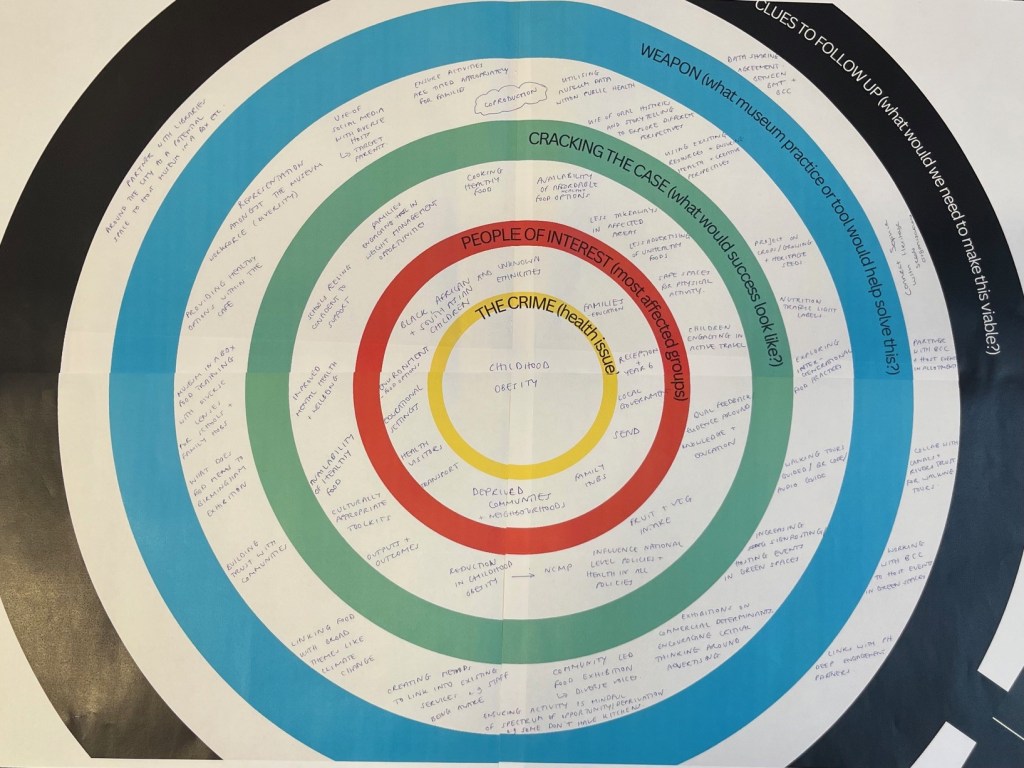
Image note
The ring format shown here has since been revised to move the CRACKING THE CASE to a shared ring for all participants, after weapon. This allows success criteria to be considered across both sectors.
Whilst this game clearly cannot solve the challenges of sector collaboration on its own, I do think play has a role in helping us get there. Drawing on game and boundary object literature, this Cluedo structure gives sectors a shared object to make sense of a problem together, and a more neutral space for expertise to meet.
References
- Briers, M., & Chua, W. F. (2001). The role of actor-networks and boundary objects in management accounting change: a field study of an implementation of activity-based costing. Accounting, organizations and society, 26(3), 237-269.
- Star, S. L., & Griesemer, J. R. (1989). Institutional ecology,translations’ and boundary objects: Amateurs and professionals in Berkeley’s Museum of Vertebrate Zoology, 1907-39. Social studies of science, 19(3), 387-420.
- Winnicott, D. W. (1991). Playing and reality. Psychology Press.
 Sophie Beckett

Leave a comment